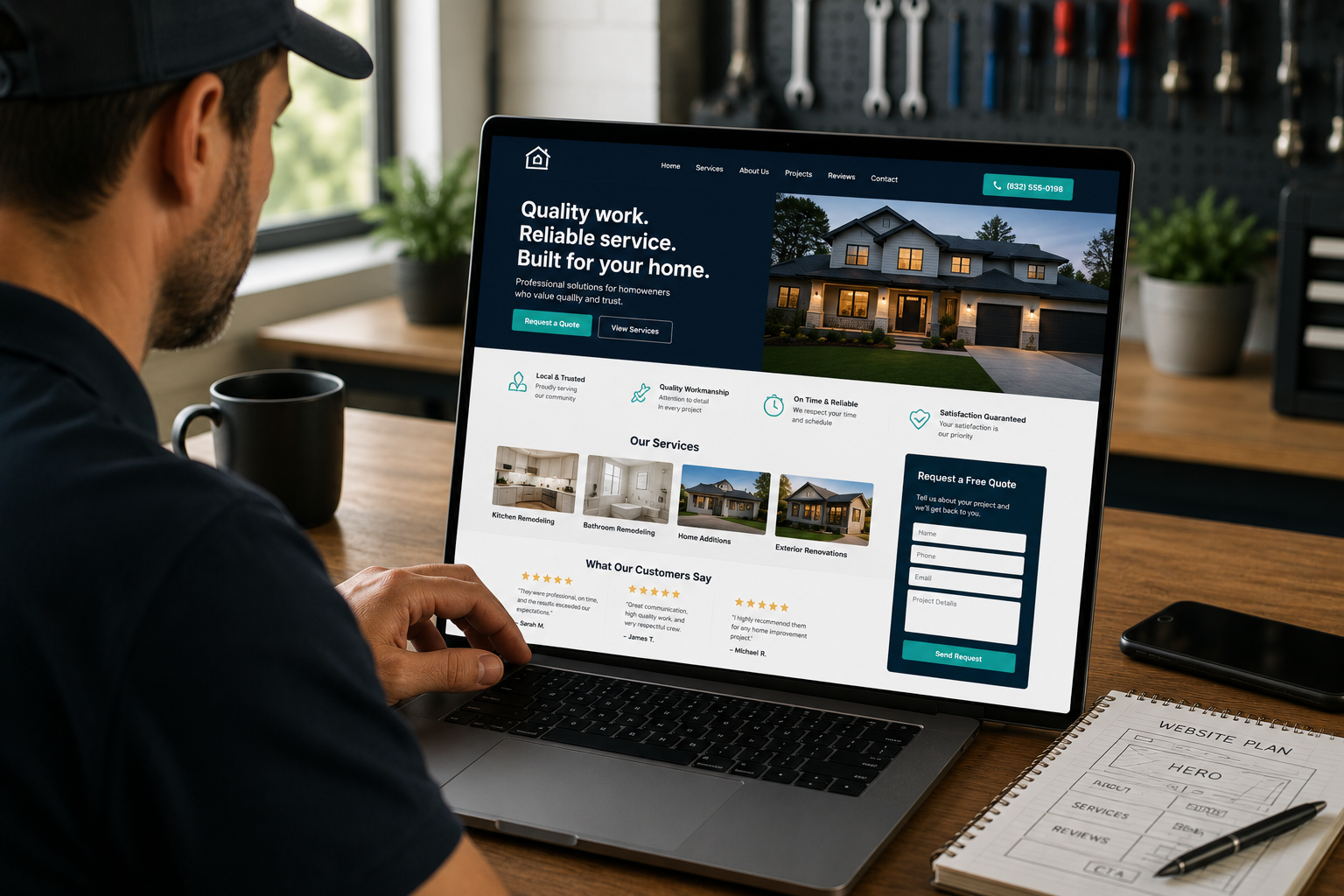
When a potential customer visits the website of a contractor or local service business, they are usually looking for a few important answers.
Can this company provide the service I need? Do they work in my area? Do they look professional? Can I trust them? How do I request a quote or schedule a service?
A good website makes those answers easy to find.
For plumbers, HVAC companies, roofers, electricians, remodeling contractors, landscapers, handyman businesses and other service providers, the website should become a practical part of the customer journey rather than simply an online brochure.
1. Make it immediately clear what your business does
Visitors should not need to search through several pages to understand what your company offers.
The first section of the website should communicate the business clearly. In many cases, that means identifying the primary service, the market you serve and the next action a potential customer can take.
Avoid generic headlines that could describe almost any company. Clear language is usually more useful than clever language.
A homeowner searching for an HVAC company wants to know that you provide HVAC services. Someone planning a remodel wants to understand that remodeling is one of your core services.
2. Give important services their own pages
One short list of services is rarely enough for a company that offers several important types of work.
Dedicated service pages allow your business to explain each service in more detail and help visitors reach information that matches what they are looking for.
For example, a remodeling contractor may offer:
- Kitchen remodeling
- Bathroom remodeling
- Home renovations
- Room additions
Instead of placing all of those services inside a few lines on the homepage, useful service pages can explain the work, answer common questions and create a clearer path for the potential customer.
This structure can also help search engines better understand what the business actually provides.
3. Make the website work well on mobile devices
Many customers search for local services from their phones. A website that looks good on a desktop computer but becomes difficult to use on a smaller screen creates unnecessary friction.
Mobile visitors should be able to read the content, navigate the website, view services and contact the company without constantly zooming or searching for buttons.
Phone numbers, quote requests and other important actions should be easy to access.
4. Show where your company provides services
Location matters for local service businesses.
A potential customer needs to know whether your company actually serves their area. Search engines also need clear information about the markets connected to your business.
Your website should identify your primary market and genuine service areas naturally.
For businesses serving several important communities, well-developed location pages may also help explain how the company serves those markets.
The goal should be useful local information, not hundreds of nearly identical pages where only the city name changes.
5. Give customers reasons to trust your company
A professional design can create a strong first impression, but trust requires more than colors and typography.
Potential customers may look for evidence that the business is active, experienced and capable of completing the work.
Depending on the company, useful trust signals can include:
- Customer reviews and testimonials
- Real project photos
- Before-and-after examples
- Information about the company
- Licenses or certifications when relevant
- Service guarantees when genuinely offered
- Clear contact information
Real information about the company is usually more convincing than generic claims about being the best.
6. Use real photos whenever possible
Service businesses have an important advantage: their work can often be shown.
Photos of completed projects, technicians, equipment and actual work can help visitors understand the business behind the website.
A roofing company can show completed roofs. A remodeling contractor can show transformations. A landscaper can show finished outdoor spaces.
Professional stock photography can sometimes support the design, but real business photos provide evidence that the company actually performs the services being promoted.
7. Make it easy to request a quote or service
A website should not make potential customers work to figure out how to contact the business.
Important calls to action should appear naturally throughout the website.
Depending on the business, that may include:
- Call now
- Request a quote
- Schedule a service
- Send project information
- Request an inspection or consultation
The correct action depends on how your company actually sells and delivers its services.
A contractor handling large remodeling projects may need a detailed project request. A service company handling smaller appointments may benefit from a simpler booking process.
8. Keep contact forms simple
Forms are useful because they allow customers to provide information even when nobody is available to answer the phone.
But asking for too much information too early can discourage people from completing the form.
Start by collecting the information needed to understand the opportunity.
- Name
- Phone or email
- Service needed
- Location
- Basic project information
Additional information can be collected later when necessary.
9. Build the website with local SEO in mind
Search engine optimization should not be an afterthought.
A well-structured website creates a stronger foundation for local search visibility by clearly organizing services, markets and useful information.
Important elements include:
- Clear page titles and headings
- Useful service content
- Logical website navigation
- Fast and mobile-friendly pages
- Clear service area information
- Dedicated pages for important services
SEO is an ongoing process, but the structure of the website determines the foundation you have to work with.
10. Website speed matters
Customers do not want to wait for a slow website, especially when they are searching from a phone and comparing several local companies.
Oversized images, unnecessary scripts and poorly optimized development can make a website feel slow.
Performance should be considered during development rather than treated only as a problem to fix later.
11. Connect the website to the rest of the business
A modern service business website can become more than a marketing page.
Quote requests, contact forms and booking requests can feed into the systems the company uses to manage opportunities and customers.
This can create a more organized journey:
- A potential customer finds the business
- They understand the service
- They submit a request
- The business receives the lead
- The opportunity is followed up
- The service is scheduled
When the website and operations work together, less information needs to be manually moved from one place to another.
A good website should help the customer take the next step.
Design matters, but the real job of a service business website is to make your company easy to understand, credible and easy to contact.
Your website is part of the customer experience
For many potential customers, your website is one of their first meaningful interactions with your company.
Before speaking with you, they may already be forming an opinion based on your services, photos, reviews, website quality and how easy it is to find the information they need.
The strongest local service websites are not necessarily the most complicated. They are clear, professional, fast, useful and built around the way customers actually choose a service provider.
Build those fundamentals first. Then your website can become a stronger foundation for local SEO, advertising, lead generation and future digital growth.
Does your website help customers choose your business?
OpperCare builds professional websites and digital solutions for contractors and local service businesses designed around visibility, credibility and customer opportunities.
Talk to OpperCare